AWS SimSpace Weaver can run city-sized simulations in the Cloud

At this morning’s Re:Invent keynote in Las Vegas, Amazon unveiled AWS SimSpace Weaver, a computing service that allows developers to run city-sized simulations at scale in the cloud. The service is designed to free simulation developers from the constraints of their own hardware.

Amazon’s proposed applications here are city managers simulating a natural disaster to test emergency response systems, as well the impact of sports games on traffic flow. These are complex situations with a lot of moving parts, which shouldn’t require watching a real life instance to gain insight. Among the other advantages to running this in the cloud is the ability to have multiple external parties view and interact with the simulation remotely in real-time.

Image Credits: Amazon

“Simulating these events requires modeling hundreds of thousands of independent dynamic entities to represent the people and vehicles,” AWS Principal Developer Advocate, Marcia Villalba, notes in a blog post. “Each entity has its own set of behaviors that need to be modeled as it moves throughout the world and interacts with other entities. Simulating this at a real-world scale requires CPU and memory beyond what you can have in one instance.”

The system works by portioning the space into instances and partions, creating the kind of grip design you see above. SimSpace Weaver’s data replication system manages memory management and networking for transferring entities across partitions. The company notes that, while SimSpace Weaver is not, itself a simulator. Instead, it creates a basis on which a simulator can be built across instances, effectively weaving (hence the name) multiple instances together into a single experience.

Find your spatial footing.

With #AWS SimSpace Weaver, you can develop real-world simulations where millions of dynamic entities—from vehicles & people to devices & machines—interact in real time. It’s positively s(t)imulating. #reinvent

https://t.co/BUlZInZYqv pic.twitter.com/CbTncrVXem

— Amazon Web Services (@awscloud) November 29, 2022

Unity and Unreal Engine 5 developers can access the system through SimSpace Weaver plug-ins. It’s available starting today in the U.S. East, U.S. West, Asia-Pacific and Europe AWS Regions. There’s no licensing fee, instead the pricing depends on the number of instances a developer integrates into the simulation.

AWS SimSpace Weaver can run city-sized simulations in the Cloud by Brian Heater originally published on TechCrunch

AWS now supports natural language forecasting queries in QuickSight Q

Amazon Web Services (AWS) has announced some notable new natural language querying capabilities that enable non-analysts to forecast future business outcomes.

By way of a quick recap, AWS first introduced its QuickSight business intelligence service back in 2015, allowing customers to visualize their data through dashboards and reports without requiring the technical prowess of a developer. Fast-forward to 2020, and AWS introduced natural language queries to the mix via QuickSight Q, enabling users to find answers simply by typing plain-English questions into a search bar, such as “show me this month’s sales by segment.”

Todays’ announcement builds on that, by serving answers to future-gazing questions.

ML-powered forecasting with Q, as AWS CEO Adam Selipsky referred to the new feature on stage at AWS re:Invent today, allows users to view business performance forecasts without involving any analysts or data scientists. All they have to do is enter “forecast” or “show me a forecast” into the search bar, followed by up to three metrics (e.g. “sales”), and Q will deliver the appropriate visualizations for that query.

On top of that, users can include filters, for example if they want to see sales for a specific region over a specific timeframe.

QuickSight Q: Forecasts with filters

Additionally, QuickSight Q will also now support natural language “why” questions, allowing non-analysts to drill down into the data and figure out what factors led to a particular outcome.

For example, if a graph shows that enrolment in a course dropped, the user might also want to know why it dropped. So they would start such a query with the word “why,” and then follow it up with a metric and a timeframe. In this case, the question could be: “Why did enrollment drop in 2021“?

QuickSight Q: “Why” questions

Both forecasting and “why” questions are available to users from today.

AWS now supports natural language forecasting queries in QuickSight Q by Paul Sawers originally published on TechCrunch

As BlockFi files for bankruptcy, how contagious will FTX’s downfall become?

Crypto lending platform BlockFi filed for Chapter 11 bankruptcy on Monday, just a few weeks after once-major crypto exchange FTX did the same. While BlockFi has been struggling to stay afloat for months now (and was even potentially going to be acquired by FTX), this latest filing signals that the bankruptcy contagion may run deeper than what the crypto industry sees at the surface.

“It is another example that the crypto winter is not over, and with the FTX debacle, it’s going to persist longer than previously expected,” Ric Edelman, founder of Digital Assets Council of Financial Professionals (DACFP) and author of “The Truth About Crypto,” said to TechCrunch.

“There is clearly a large amount of self-dealing and excessive leverage in the system, and until most of that is washed out through business failures, M&A, and regulatory actions, the crypto winter will persist.”Ric Edelman, founder of Digital Assets Council of Financial Professionals

With BlockFi now in the midst of bankruptcy proceedings alongside FTX, Celsius, Three Arrows Capital and Voyager, others in the crypto space are wondering if and when the next crypto firm will find itself on the chopping block.

“The level of intercompany investment within the blockchain and crypto community is unusually high, so the level of contagion is likely to be much higher than what we saw within the traditional financial community in 2008-2009,” Sam Dibble, partner at Baker Botts, said to TechCrunch.

“Unfortunately, the complexity of these intercompany investments is not fully known at this point and so the companies themselves probably don’t know how badly they will be impacted,” Dibble added. “My guess is that the entire industry will be impacted somewhat by the FTX and BlockFi bankruptcies, with a significant number of severe casualties.”

As BlockFi files for bankruptcy, how contagious will FTX’s downfall become? by Jacquelyn Melinek originally published on TechCrunch

Snapchat complies with the California Privacy Rights Act with a new toggle switch for users

Snapchat is adding a new privacy setting that enables users based in California to better protect their sensitive personal information. The company confirmed it’s rolling out a feature designed to comply with the California Privacy Rights Act (CPRA), which takes effect on Jan. 1, 2023, and applies to personal data collected on or after Jan. 1, 2022.

In November 2020, California residents voted to pass the CPRA, also known as Proposition 24, which builds on an earlier consumer privacy law, the California Consumer Privacy Act (CCPA) of 2018.

While the CCPA gave residents the right to access and delete personal information held by businesses and opt out of the sale of that data, the new law puts into place further requirements for businesses around their data collection practices and data retention. It additionally introduces new notification requirements and clarifies that users have the right to opt out of both the sharing and the sale of their personal information, while also adding a new category of “sensitive data.”

The law created the California Privacy Protection Agency to enforce the state’s privacy laws, as well as investigate violations, and assess penalties if warranted.

Consumers based in California, meanwhile, are to gain the right to not only know who’s collecting their information, but also be able to access it, correct it, delete it and transfer it, and to stop its sale and sharing, without being penalized as a result. As part of this, they’re also to gain the ability to access their options through “easily accessible” self-serve tools.

Snapchat’s implementation would seemingly address the latter as it presents a simple toggle switch under its Privacy Controls section in the app’s Settings screen. Here, users will be presented with a new option at the bottom of the list that reads “California Privacy Choices.”

A tap into this screen, (as spotted by competitive intelligence provider Watchful — see below image) reveals a new option to “Limit the Use of Sensitive Personal Information.” This page explains that enabling the setting would require Snapchat to limit the use of users’ personal info, including things like precise geolocation.

Image Credits: Watchful

The setting, however, is appearing in the Snapchat app for all U.S. users — even those who don’t live in the state.

Snapchat confirmed the new privacy feature is rolling out in compliance with the CPRA, but notes it only functions for those users in California.

The addition is interesting as it demonstrates how a popular mobile app has chosen to comply with the new legislation. And unlike on Facebook — where settings are buried, difficult to find, and constantly being relocated — Snapchat’s new privacy feature is relatively easy to find. All of the app’s settings are available from one main screen, organized into sections. So the new CPRA-compliant setting isn’t something users have to dig around to find.

Snapchat complies with the California Privacy Rights Act with a new toggle switch for users by Sarah Perez originally published on TechCrunch

AWS launches DataZone, a new ML-based data management service

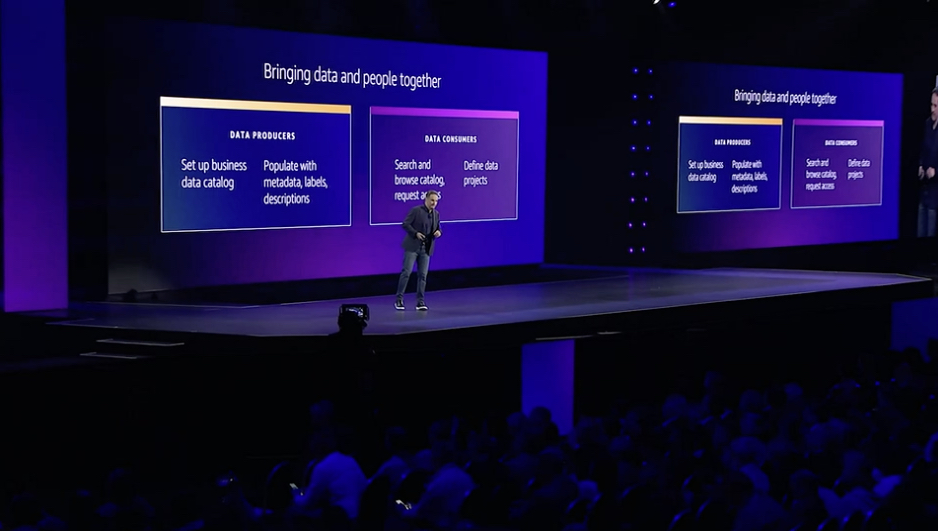
At its re:Invent conference, AWS today announced Amazon DataZone, a new data management service that can help enterprises catalog, discover, share and — most importantly — govern their data. The nifty part here is that AWS is using machine learning to help businesses build these data catalogs and generate the metadata to make it searchable.

“To unlock the full power the full value of data, we need to make it easy for the right people and applications to find, access and share the right data when they need it — and to keep data safe and secure.” AWS CEO Adam Selipsky said in today’s keynote.

The tool will provide users with fine-graned controls to manage and govern this data. That’s long been a major problem for enterprises, but it has only gotten harder as the amount of data has increased, ensuring that the right users have access to the right data, without compromising personally identifiable information, for example.

“Data zone enables you to set data free throughout the organization safely by making it easy for admins and data stewards to manage and govern access to data,” Selipsky explained. “And it makes it easy for data engineers, data scientists, product managers, analysts and other business users to discover, use and collaborate around that data to drive insights for your businesses.”

DataZone users will get access to a portal where they can set up their data catalog and define the taxonomy. Once DataZone is connected to a data source, it’ll use machine learning to populate its catalog with its metadata and users can add additional labels and descriptions as needed.

In a somewhat related announcement, AWS also yesterday launched its Digital Sovereignty Pledge, promising to give users the tools they need to control where their data is stored and accessed. DataZone does offer some of those controls, though its focus is obviously not on digital sovereignty.

AWS launches DataZone, a new ML-based data management service by Frederic Lardinois originally published on TechCrunch

Lordstown Motors begins shipping its Foxconn-made EV pickup trucks

Lordstown Motors has starting shipping its all-electric Endurance pickup trucks manufactured by Foxconn, a milestone that seemed impossible earlier this year.

Lordstown Motors, which has experienced investigations, executive upheaval and a shortage of capital, said Tuesday that its full-sized EV truck received full homologation with certification from both the EPA and CARB that clears the way for the company to start customer sales.

The first batch of 500 EV pickups, made at an Ohio factory now owned by Taiwanese hardware manufacturing company Foxconn, are on their way to fleet customers, according to the company. The announcement sent shares of Lordstown Motors stock up 3.79%.

Lordstown Motors has moved from one dramatic event to another in its short life as a company. Workhorse Group founder and former CEO Steve Burns started Lordstown Motors in 2018. The startup immediately gained attention for its deal with GM to buy the legacy automaker’s soon-to-be-shuttered factory in Lordstown, Ohio. GM invested $75 million into Lordstown.

The company became a political tool at times; the unveiling of its Endurance pickup truck geared towards contractors was largely used as a campaign stop for then-Vice President Mike Pence. Lordstown also sustained a series of setbacks, which seemed to ramp up after it became a publicly traded company through a merger with a special purpose acquisition company.

In March 2021, Hindenburg Research, the short-seller firm whose report on Nikola Motor led to an SEC investigation and the resignation (and ultimately the indictment) of its founder, issued a report disputing Lordstown’s claims it had booked 100,000 pre-orders for its truck. The firm also alleged that Burns paid consultants for every truck pre-order as early as 2016 while he was leading Workhorse.

By summer 2021, Burns and CFO Julio Rodriguez had resigned, the company warned it was running low on capital and investors learned it was being investigated by the Department of Justice.

Foxconn, best known as the maker of Apple’s iPhone, came to the rescue in September 2021 and bought the Lordstown factory for $230 million. Foxconn also agreed to manufacture the pickup truck for Lordstown under a joint venture contract. Foxconn increased its investment in Lordstown Motors in November 2022 by buying $170 million in common stock and newly created preferred shares.

Foxconn holds all of Lordstown’s outstanding preferred stock and 18.3% of its common stock on a pro forma basis.

Lordstown Motors begins shipping its Foxconn-made EV pickup trucks by Kirsten Korosec originally published on TechCrunch

Amazon’s new Alexa feature uses AI to create animated kids’ stories on Echo Show

Amazon announced today the launch of “Create with Alexa,” a new AI tool for kids that generates animated stories. The company first revealed the feature in September. “Create with Alexa” launched in the U.S. today, November 29, across supported Echo Show devices and is available in English.

To craft a story, a child says, “Alexa, make a story,” and then answers prompts, the company explains in its blog post. The child selects from three themes: “space exploration,” “underwater” or “enchanted forest,” and then chooses the story’s hero, a color scheme and adjectives like “silly,” “happy” or “mysterious.”

The AI then generates a five-to-ten-line story based on the answers. The story comes with a background image, animations, sound effects, music and more. Amazon claims that the story will be different every time, even if the same child chooses the same exact prompts.

Users can also save the story in their personal media gallery and replay it whenever they want. Soon, they’ll be able to share the story with their family and friends, Amazon added.

Image Credits: Amazon

Nico Bishop, a UX designer, said that Alexa’s AI-assisted story creation would evolve over time. “Kids will want to be able to say, ‘I want to see a wall of chocolate,’ and soon we expect we’ll be able to do that,” Bishop said in a statement. She also noted that the company is working to improve graphic latency, sound effects and music capabilities.

“We envision a world where anyone can bring their ideas to life in the form of digital creations just by using a few spoken words,” said Eshan Bhatnagar, head of product for Alexa AI. “And Alexa will be right with them, assisting them as their co-creator.”

Some AI art systems like Stable Diffusion lack safeguards, making it easy for users to generate inappropriate artwork. However, Amazon’s “Create with Alexa” is targeted toward young kids, so there are content filters in place, Bhatnagar explained. And since it’s a child-directed Alexa feature, a parent needs to enable it on the device before their child can use it.

Amazon’s new Alexa feature uses AI to create animated kids’ stories on Echo Show by Lauren Forristal originally published on TechCrunch

Google/iHeartMedia will pay $9.4M to settle FTC charges for ‘deceptive’ Pixel 4 radio ads

The Federal Trade Commission this week announced that it has settled lawsuits against Google and iHeartMedia relating to “deceptive endorsements” of the Pixel 4 phone. According to a statement issued by the FTC, nearly 29,000 ads were aired featuring radio personalities.

The suit notes specifically that the promoters in question never used the handset, in spite of claiming to have had experience with the device. Google is said to have paid iHeartMedia – the United States’ largest radio owner – along with 11 other networks in 10 major markets millions to promote the product.

Those endorsements included scripted lines, including “It’s my favorite phone camera out there, especially in low light, thanks to Night Sight Mode,” “I’ve been taking studio-like photos of everything,” and “It’s also great at helping me get stuff done, thanks to the new voice activated Google Assistant that can handle multiple tasks at once.”

“Google and iHeartMedia paid influencers to promote products they never used, showing a blatant disrespect for truth-in-advertising rules,” Bureau of Consumer Protection Director Samuel Levine said in a statement provided by the FTC. “The FTC will not stop working with our partners in the states to crack down on deceptive ads and ensure firms that break the rules pay a price.”

Google and iHeartMedia have agreed to settle the suit to the tune of $9.4 million. The news arrives as federal regulators are taking a closer look at regulation around big tech, including a $400 million Google settlement for data tracking and increased scrutiny over potential monopolistic practices.

“We are pleased to resolve this issue,” Google Spokesperson José Castañeda said in a statement offered to TechCrunch. “We take compliance with advertising laws seriously and have processes in place designed to help ensure we follow relevant regulations and industry standards.”

We have reached out to iHeartMedia for addition comment.

Google/iHeartMedia will pay $9.4M to settle FTC charges for ‘deceptive’ Pixel 4 radio ads by Brian Heater originally published on TechCrunch

A new tool ‘Movetodon’ makes it easier to find your Twitter friends on Mastodon

Open-source Twitter alternative Mastodon has seen sizable growth following Elon Musk’s Twitter acquisition, topping a new milestone of 1 million monthly active users in just over a week after the deal closed. But one of the many challenges for users coming to Mastodon for the first time is in re-creating their network of friends and followers they had built up over the years on Twitter. A new tool called Movetodon aims to make the transition from Twitter to Mastodon easier by allowing users to easily find and follow their Twitter friends on the open-source social network with minimal work.

There are already a few tools to find Twitter friends on Mastodon, like Debirdify, Twitodon and Fedifinder. However, some current tools ask users to connect their Twitter account, scan their network then export that data into a CSV file for import into Mastodon. This is useful if you want to simply import all your Twitter friends who have Mastodon accounts, but doesn’t allow you to easily curate your network if you’d like a fresh start.

Movetodon’s creator, a German software developer Tibor Martini, says he had used these tools himself and acknowledged they worked for his purposes. But he thought the overall experience was a little lacking.

“For a few days, I used some of the other tools, i.e. Fedifinder and Debirdify, and found them great,” he told TechCrunch, in an email. “They did what was needed — exporting your friends’ accounts from Twitter and importing them to Mastodon. However, the process to do so was not very sophisticated. You had to download a CSV file and import it back into Mastodon,” Martini explained. “Also, some of the tools didn’t have any styling at all so they looked very ‘raw.’ Those aspects made it harder for people who already struggled to find ‘the right’ mastodon instance,” he added.

Martini said he wanted to build a tool that would make it simpler for non-tech-savvy people to find their friends on Mastodon, including if they were accessing the service on mobile.

He started working on the concept for Movetodon at the end of October and then began coding around mid-November.

Though only launched five days ago, Movetodon is already becoming a popular tool for those who are trying to flee Twitter. Martini says his server logs indicate more than 50,000 users have tried Movetodon in just the past week. His post about the service was also reshared on Mastodon nearly 2,000 times and was tweeted about several hundred times.

To take advantage of Movetodon, users have to log in to both apps, Twitter and Mastodon, and authorize Movetodon to get started. The tool then automatically generates a list of friends who are also on Mastodon. In tests, we also found that Movetodon helpfully handled the API limits it encountered by pausing the list generation and displaying a countdown in seconds as to when it would resume.

Image Credits: Movetodon in action

When the list generation is complete, you’ll be able to follow individual users by clicking a button or you can click to follow them all at once. You can also sort the list by when users joined Mastodon to make the new accounts pop up to the top of the list.

The developer says his tool works by looking at the relevant fields on Twitter where users often share their Mastodon account information — like their bio, user name, location field, URL field, or in their pinned tweet. It then used Regex to extract possible Mastodon handles and URLs. With the Mastodon API, it determines if the handle is actually a Mastodon account, or if it’s something else — like an email address. The tool also fetches a list of all your current friends on Mastodon to show you if you already follow each other or not.

The data Movetodon accesses is never stored on its server, and both app connections ask for limited permissions. For instance, on Twitter, Movetodon can only read information, not post or follow. On Mastodon, Movetodon asks for limited write permissions to allow users can follow other people on the platform.

While Martini’s day job is as a Team Lead for Social Media at the German publisher stern, he says he may continue to develop Movetodon further based on user feedback. For instance, he added the “follow all” button in response to users’ requests. Users are also now asking if they could use the tool to find accounts from their Twitter Lists, as well.

Even if other Twitter alternatives added APIs in the future, Martini doesn’t think he would build tools for them, as he prefers Mastodon. (Movetodon shows he joined the open-source social network 2,245 days ago!)

“Personally, I see some advantages at Mastodon: It already has a great user base, is privacy friendly, and has already years of experience in managing and developing the platform,” he says.

A new tool ‘Movetodon’ makes it easier to find your Twitter friends on Mastodon by Sarah Perez originally published on TechCrunch

Dropbox acquires Boxcryptor assets to bring zero-knowledge encryption to file storage

Dropbox has announced plans to bring end-to-end encryption to its business users, and it’s doing so through acquiring “key assets” from Germany-based cloud security company Boxcryptor. Terms of the deal were not disclosed.

Dropbox is well-known for its cloud-based file back-up and sharing services, and while it does offer encryption for files moving between its servers and the destination, Dropbox itself has access to the keys and can technically view any content passing through. What Boxcryptor brings to the table is an extra layer of security via so-called “zero knowledge” encryption on the client side, giving the user full control over who is allowed to decrypt their data.

For many people, such as consumers storing family photos or music files, this level of privacy might not be a major priority. But for SMEs and enterprises, end-to-end encryption is a big deal as it ensures that no intermediary can access their confidential documents stored in the cloud — it’s encrypted before it even arrives.

Moving forward, Dropbox said that it plans to bake Boxcryptor’s features natively into Dropbox for business users.

‘Premier partner’

Founded in 2011, Boxcryptor protects companies’ data across numerous cloud services including OneDrive, SharePoint, Google Drive, and Dropbox. Indeed, Dropbox was already one of Boxcryptor’s “premier partners,” working closely with the cloud giant to ensure its encryption smarts play nicely with Dropbox’s cross-platform file storage.

It’s worth digging a little bit into the specific wording of the deal announced today though. Both companies are careful not to call this an all-out acquisition: Dropbox said that it’s acquiring “key assets,” while Boxcryptor says that Dropbox has acquired its intellectual property, including “key technology assets.”

But for all intents and purposes, this seems like a good old-fashioned acquisition. In a blog post published today, Boxcryptor founders Andrea Pfundmeier and Robert Freudenreich say that their “new mission” will be to embed Boxcryptor’s technology into Dropbox. And after today, nobody will be able to create an account or buy any licenses from Boxcryptor — it’s effectively closing to new customers.

“By providing our technology and deep-expertise to a global tech company like Dropbox, we’ll be able to better scale our security capabilities through Dropbox’s global platform and provide an elevated encryption experience for users,” they wrote. “This will ensure even more people are able to focus on the work that matters, knowing that their content is even more safe and secure.”

But there are reasons why the news as being packaged the way it has. The company is continuing to support existing customers through the duration of their current contracts. Boxcryptor has commitments and contracts in place, and it wants to ensure nothing is lost in translation — it’s stressing that no keys, contracts, or data will be transferred over to Dropbox, and everything will remain where it currently is in its German datacenters.

Dropbox acquires Boxcryptor assets to bring zero-knowledge encryption to file storage by Paul Sawers originally published on TechCrunch

Pin It on Pinterest